
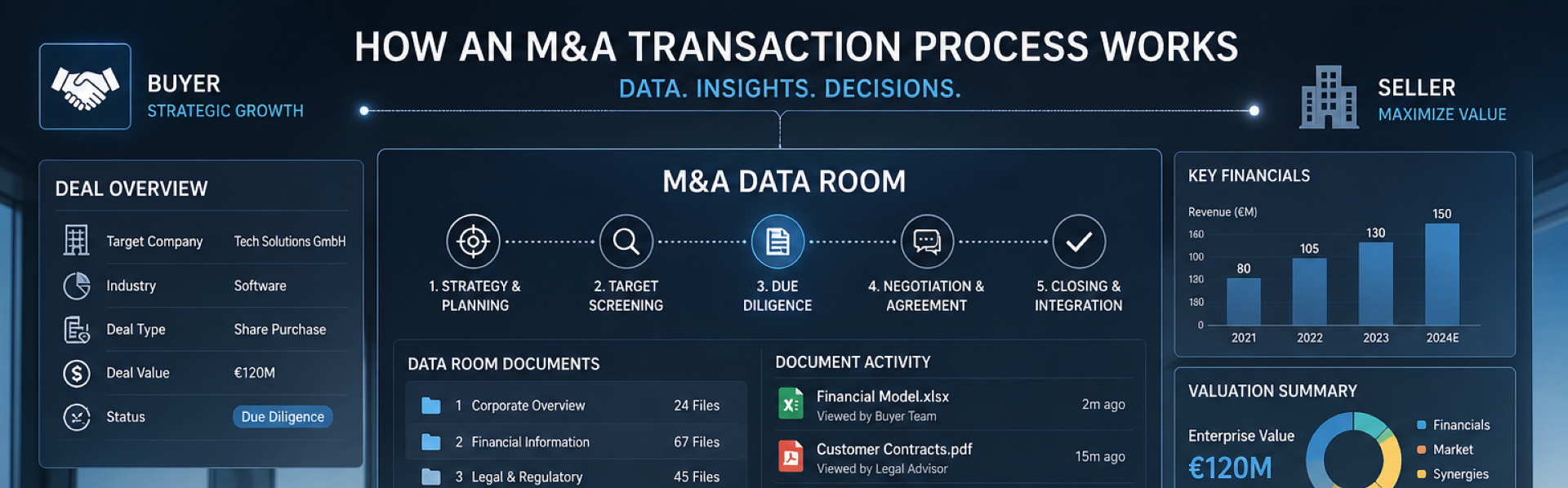
How an M&A Transaction Process Works
We recently talked through the signs that it might be time to sell your company. But what happens after you make that pivotal decision?
If you’ve never steered a business through the M&A process before, the key thing to keep in mind is that it won’t be quick.
“Even straightforward transactions often take longer than anticipated,” says Jonathan Simnett, managing director at Hampleton Partners. “This can be due to regulatory reviews, financing dependencies, or negotiation deadlocks. What was expected to close in months can stretch out to a year and more.”
Knowing what this process entails, and where value is created or lost, can make the difference between a smooth, high-value exit and a disappointing, drawn-out outcome. Let’s consider the main stages in turn.
Stage 1: Preparation and planning
The first step is making your company sale-ready. This means conducting a thorough internal review of your financials, your intellectual property, your customer contracts, and your operational scalability. Documents covering your ownership structure, finances, IP, HR information and legal contracts should be collated in a virtual data room: an encrypted cloud-based repository of corporate information, to be later shared with potential buyers and their advisory teams during the due diligence and negotiation process.
The preparation stage also means vetting your company for potential vulnerabilities around cybersecurity, regulatory compliance and employee retention – anything that will be subjected to scrutiny by potential buyers. One of the benefits of engaging the services of an M&A advisory firm is that they will know exactly what red flags to look for, and help shoulder the burden of your internal audit so you can continue running your business.
“One common surprise is how disruptive the preparation process can become internally,” says Jonathan Simnett. “Without the support of specialist M&A advisory leadership, teams often underestimate the time and attention required, potentially leading to delays in day-to-day operations or missed strategic or financial goals.”
Stage 2: Market outreach
Once the preparation stage is complete, you’ll be ready to formally introduce your business to potential buyers in a controlled and strategic way. A good M&A advisor will be able to draw on their connections and/or look beyond their network to pinpoint credible, complementary buyers, such as other businesses in your sector or private equity firms with an interest in your tech niche.
Your M&A advisor may approach potential buyers with a teaser, which is a very concise, anonymised outline of your business laying out key metrics and investment rationales. Once potential buyers are interested enough to sign Non-Disclosure Agreements, they may then be provided with your Confidential Information Memorandum (CIM), a far more detailed breakdown of your company’s structure, products and financial performance.
The overall aim is to attract multiple strategic and financial buyers while carefully managing confidentiality to avoid disrupting your daily operations or creating unease among employees and customers. During this phase, interested buyers will begin preliminary evaluations and may submit non-binding indications of interest.
Stage 3: Due diligence and negotiation
Ideally, you will receive a number of competing offers, allowing you to select your preferred buyer. Having read the buyer’s Letter of Intent (LOI), which outlines the terms of a potential acquisition, you will grant them a period of exclusivity, which means you won’t negotiate with other potential buyers while they carry out their due diligence.
The latter entails a deep dive into your business, with the buyer scrutinising your technology, performance metrics, operational risks, customer contracts, supply chains, and revenue sustainability. There may also be negotiations around key deal terms, including the proposed price and payment structure – for example, whether it will be an all-cash deal or an earn-out where part of the sale price is contingent on future performance.
“Companies are frequently surprised by the depth and persistence of due diligence, which has become increasingly stringent in recent years,” says Jonathan Simnett. “Buyers may revisit issues multiple times, request increasingly granular data, or uncover risks that were assumed to be immaterial. This can lead to last-minute re-negotiations on price, terms, or warranties.”
You will need to be responsive and transparent while simultaneously protecting your interests and negotiating hard. Experienced M&A advisors will help you walk this fine line and achieve an optimal outcome.
Stage 4: Signing and closing
This is the home stretch, with the buyer completing their due diligence checks and ready to commit to the purchase. Both parties finalise and execute the definitive legal agreements, including the Sale and Purchase Agreement (SPA). This lays out all terms, including price, payment mechanics, warranties, indemnities, and any conditions that must be met before the deal completes.
This is known as the “signing”, while the actual transfer of funds, assets and ownership is the “closing”. This often happens at some point after the signing, and can be subject to regulatory approval and/or internal restructuring.
While this will undoubtedly be cause for celebration, it’s worth remembering that the work doesn’t end there. As Jonathan Simnett puts it: “Many companies underestimate post-deal complexity. Integration of systems, processes, teams, and culture can present a bigger challenge than closing the deal itself. Synergies projected during negotiations may take longer to realise or fail entirely without focus and disciplined execution.
“In short, beyond the financial mechanics, it’s the human, operational, and timing realities of M&A which tend to present the biggest surprises to be prepared for!”
If you’re planning the sale of your business and would like expert guidance on the entire process from dealmakers with decades of tech industry experience, drop Jonathan an email to get the conversation started.
Don’t forget to read our free M&A market reports for our latest insights into acquisition trends across Digital Commerce, Enterprise Software, Autotech and other major tech sectors. Our reports reveal what acquirers are looking for, discussing the most important market metrics as well as significant deals in each sector. You can also subscribe to ensure you’re notified whenever our newest reports are published.
AI Generated Image